
DigiBauRech - Digital invoice items for the construction industry
Making data for sustainability reporting easily accessible and well-organized
Making taxonomy, life cycle assessment rules, cost auditing, and construction documentation manageable for small and medium-sized construction companies: That was the goal of DigiBauRech, an IT project launched by the Federal Construction Guild in collaboration with the Austrian construction information service provider Inndata Datentechnik.
The project has now been completed. The results were presented at the closing event on September 23, 2026.
Background
Making Data Sources Available
When construction companies need to document the life cycle assessment of their construction projects, they essentially require three things: the construction products used, along with their exact properties and EPD parameters, as well as the actual quantities installed. This information is generally available, but it is scattered across delivery notes and countless manufacturers’ websites. In this form, comparing and utilizing it requires a great deal of effort.
Project Objective
To provide verifiable line-item data—including item details, quantities, prices, and product characteristics (e.g., EPD)—for any software system used by construction companies. This enables any software system to obtain structured, documentable information from the ERP systems of the respective building materials dealers—combined with content data from the building materials industry—via a web service valid throughout Austria, and to use this information for documentation purposes, cost calculations, post-project cost analyses, and taxonomy checks.
To achieve this, the specific requirements for content and interfaces must be coordinated with retailers, industry, and software companies, and a cost-effective IT solution must be found for as many market participants as possible (retailers, industry, and trade). The existing structures of the project partner Inndata can be utilized for this purpose.
What has been implemented?
- Structured EPD Data: The Environmental Product Declarations (EPDs) for building materials were converted from unstructured documents into a uniform, machine-readable format. They are available as Excel and JSON files and have been coordinated with leading software vendors.
- Common Interface (Gateway): Through a single, universally applicable interface, software systems can retrieve product data, quantities, and prices—including EPD parameters—for purposes such as documentation, cost accounting, post-calculation, and taxonomy verification.
- Pilot Project with Building Materials Retailers and Online Ordering: The integration was tested using BAUMAT’s REST interface. Orders provide the data both as interface output and in a human-readable format. A clear migration path is in place for other systems.
- Test Operation and Documentation
Benefits
- For the construction industry: All necessary data is delivered via a single interface in a format compatible with the company’s IT systems. This makes it significantly easier to meet future documentation requirements.
- For software providers: All that’s needed is a connection to the shared interface. Separate interfaces with each individual market participant are not necessary.
- For retailers: They receive their data easily and can maintain their proven ordering processes.
- Digital document management also saves resources such as paper and time, and reduces errors in workflows.
New Framework Conditions
Since the project began, the regulatory environment has changed significantly:
- Omnibus Regulation: It eases reporting requirements (CSRD, Supply Chain Directive, EU Taxonomy), extends deadlines, and narrows the scope of affected parties.
- Building Efficiency Directive (EU 2024/1275): It is being implemented nationally via OIB Directives 6 and 7. New buildings larger than 1,000 m² will be affected starting in 2028; other new buildings and major renovations will be affected starting in 2030. GWP declarations require EPDs.
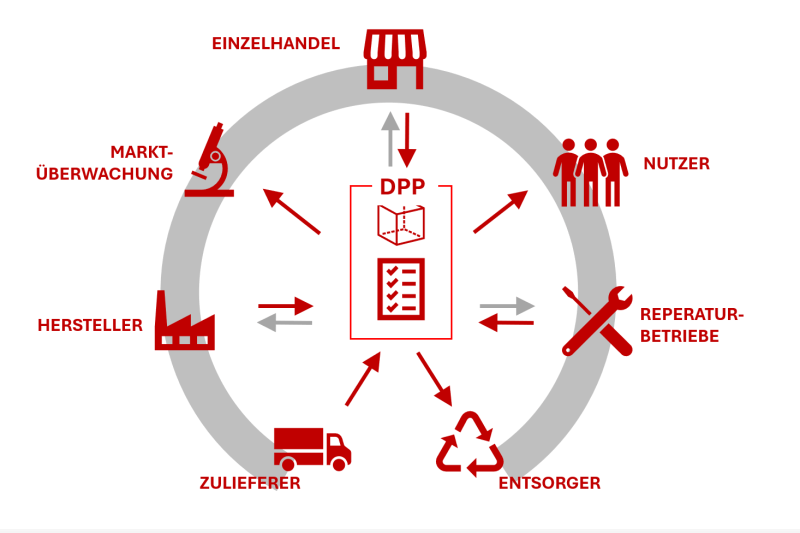
- New Construction Products Regulation (EU 2024/3110) and Ecodesign Regulation (EU 2024/1781): Sustainability becomes an essential performance characteristic of construction products. Declarations of performance will be machine- and human-readable and will become part of the Digital Product Passport (DPP) in the future.
The project results will remain usable for this purpose, as structured EPD data forms the basis for the DPP.
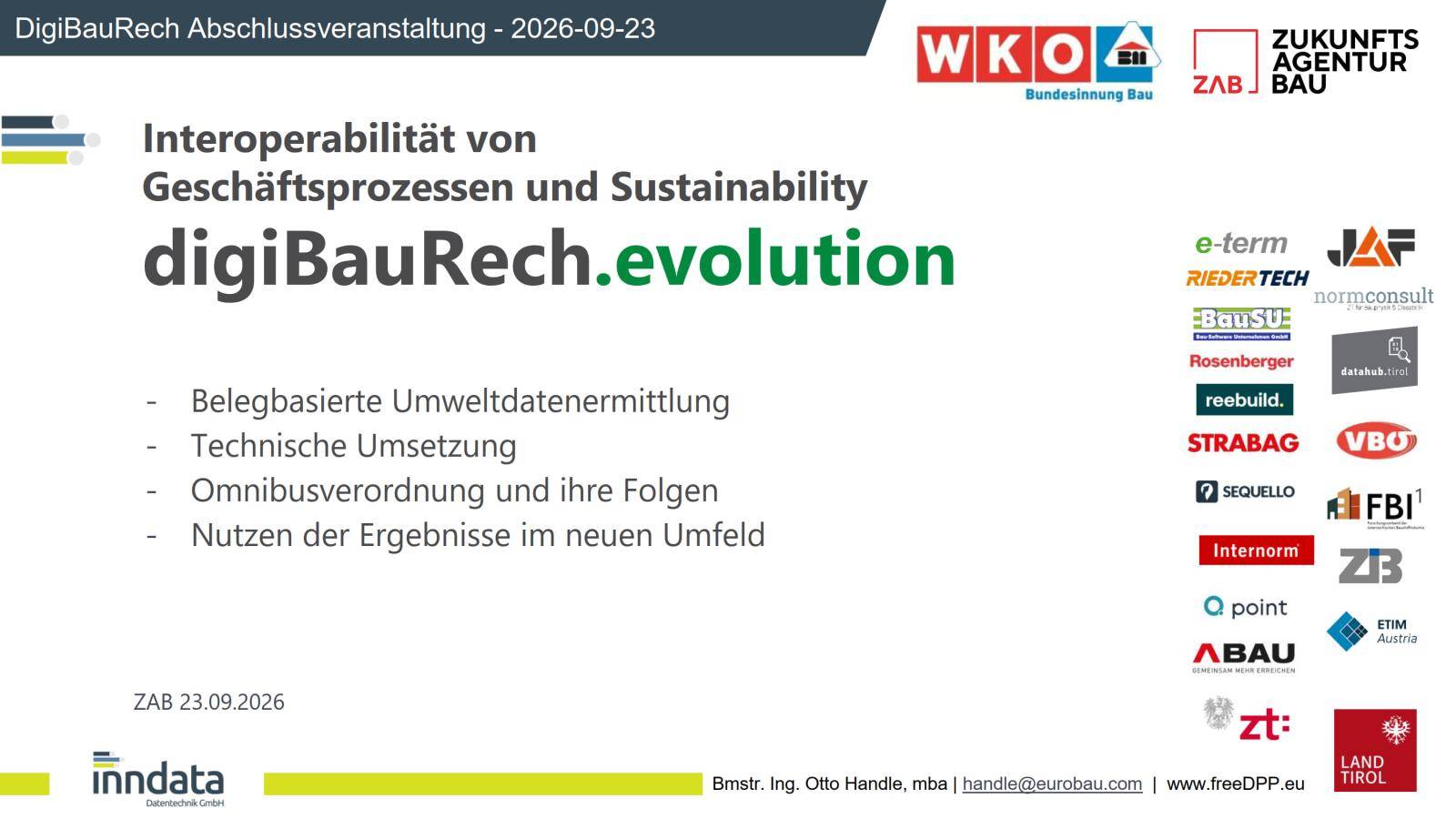
What’s Next? – digiBauRech.evolution
Building on DigiBauRech, the focus is on sustainability in buildings using the Digital Product Passport: the building model (BIM) and linked product data (DPP) combine to form a digital building logbook. With freeDPP (www.freeDPP.eu), there is already an open-source solution available to try out.
Results-Links
More information on digibaurech

A video from YouTube will be displayed here once you agree. The video loads content from Google.
For more information, see our privacy policy.